
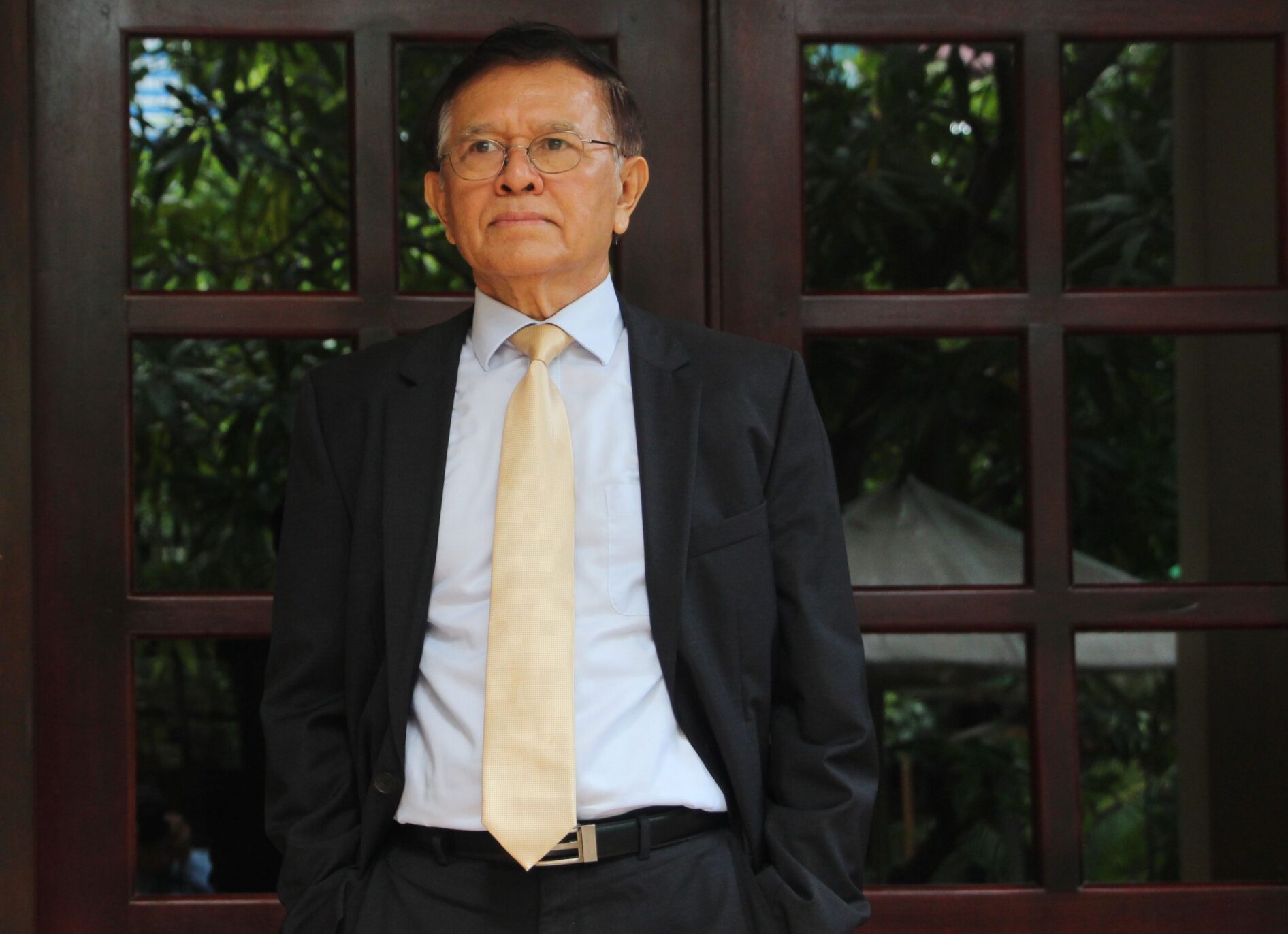
The Phnom Penh Appeals Court on April 30 upheld the 27-year house-arrest sentence handed to former opposition leader Kem Sokha and added a five-year ban on international travel that takes effect after the sentence ends. The court did not publish its reasoning. By the close of business that same day, no Cambodian government institutional statement on the verdict was on the public record. CamboJA reported that government spokesperson Pen Bona did not respond to a request for comment. Sokha’s defense lawyer Pheng Heng told reporters after the verdict that “the government ruled by the Cambodian People’s Party (CPP) should seek national reconciliation” and that “today’s decision is not as expected.”
The case has run on Article 443 of the Cambodian Criminal Code since the day of arrest. Article 443, as rendered in English translation, defines conspiracy with a foreign power as “the act of having secret agreement with a foreign state or its agents, with a view to fomenting hostilities or acts of aggression against the Kingdom of Cambodia,” and carries a sentence of 15 to 30 years. The threshold has three statutory elements: secret agreement, foreign state or its agents, intent to foment hostilities or aggression. The publicly available text is an English translation. The Royal Gazette Khmer text was not retrieved for this analysis.
The Royal Government of Cambodia statement of September 3, 2017 named the statute by article number, named a video clip broadcast by the Cambodian Broadcasting Network in Australia as the principal exhibit, named “other evidences collected by the competent authority,” and asked the public to “remain calm and allow the court to work on the case in its capacity as a competent authority in line with laws and procedures in force.” That statement is the only Cambodian institutional reasoning on this case currently in public circulation.
Sokha’s own defense addresses the third statutory element directly. In his April court statement, he said he had never conspired with any foreign country at the cost of the lives of Cambodian citizens or the loss of national territory, and that he had acted in a spirit of nonviolence and national unity. The defense’s substantive position is on the record. The court’s engagement with that position, in writing, is not.
The procedural sequence is on record. Sokha was arrested on the night of September 3, 2017 by members of then-Prime Minister Hun Sen’s personal bodyguard unit. He was held at Correctional Center III prison in Tboung Khmum province for more than a year before being moved to house arrest in 2018. The UN Working Group on Arbitrary Detention adopted Opinion No. 9/2018 on April 19, 2018, finding his deprivation of liberty arbitrary under categories I, II, III, and V of the Working Group’s classification, in contravention of articles 2, 7, 9, 10, 11, 19, and 21 of the Universal Declaration of Human Rights. The trial opened on January 15, 2020 and ran 66 hearings over almost three years, with a 21-month halt that FIDH attributed to COVID-19 conditions. Conviction came in March 2023. Appeal proceedings opened in January 2024, were suspended in September 2024 without published reason, and resumed in April 2026 before the verdict on April 30. Eight years and eight months elapsed between arrest and final appeal ruling.
The trial-court written reasoning is publicly available. The appeal-court reasoning, as of close of business April 30, was not.
Within hours of the ruling, four Western embassies, the European Union delegation, two rights organizations, and the defense lawyer were on the record. The British Embassy issued a written statement: “We would like to see Kem Sokha released and his political freedoms restored. We believe this would help strengthen democracy in Cambodia.” Australia’s ambassador, Derek Yip, wrote on X that the verdict was “deeply disappointing” and urged Cambodia to “take steps to expand civic space and create the conditions for genuine, contested elections.” Germany’s ambassador, Stefan Messerer, posted that the ruling “does not dispel the concerns that have accompanied these proceedings over many years.” Canada’s ambassador, Christian DesRoches, said he regretted the decision, citing the importance of political opposition, civil society, and a free press to democratic governance. The EU delegation expressed concern and called for political pluralism in Cambodia. Human Rights Watch deputy Asia director Bryony Lau called the prosecution “bogus” and called for Sokha’s immediate release and the unconditional restoration of his political rights. Licadho operations director Am Sam Ath called for dialogue and negotiation to resolve political tensions. Reuters, AP, Xinhua, Cambodianess, CamboJA, HRW, FIDH, and Mirage News carried same-day coverage.
Three documentary points sit on the record alongside the same-day international response.
Without the appeal court’s written reasoning, the public cannot independently assess how the court engaged the three elements of Article 443. Whether it found a secret agreement, whether it identified the foreign state or agents, whether it determined intent to foment hostilities or aggression, none of these is visible in the published record. Sokha’s denial in court addresses the third element directly. The court’s answer to that denial, in writing, is not visible. Judicial silence on reasoning at the appeal stage is procedurally normal in some legal systems and may follow Cambodian appellate practice; the documentary record on the question runs only as far as the silence itself.
The 2017 RGC statement remains the only Cambodian institutional reasoning on this case currently in public circulation. Subsequent Cambodian institutional reasoning, on the 2023 conviction or the 2026 appeal verdict, is not on record. The executive’s available position is that the 2017 statement of charges and the court’s continuing competence over the matter together constitute the institutional answer; that position is one the executive has not stated publicly in the post-verdict window and that the documentary record neither confirms nor rules out.
The 2013 speech itself, the central exhibit of the case, exists in the public record only in fragments. ABC News in September 2017 preserved material from a speech Sokha delivered to the Cambodian diaspora in Melbourne in 2013. AP in its April 30 coverage described the speech as “discussing political advice from U.S.-based pro-democracy groups.” The complete primary record is not in public circulation. The merits of how the speech maps onto the three statutory elements of Article 443 cannot be independently assessed from public material.
The framework around the case is documentable through dated instruments. The 1991 Paris Peace Agreements set the framework for liberal democratic pluralism. The 1998 post-election impasse was resolved through Sihanouk-mediated negotiation involving Hun Sen, Norodom Ranariddh, and Sam Rainsy, producing a coalition government and parliamentary roles for opposition leaders, with the Senate added by constitutional amendment in 1999. The 2014 Culture of Dialogue agreement between Hun Sen and Sam Rainsy resolved the post-2013 election crisis through negotiated recognition of opposition role, returning the CNRP to its parliamentary seats and giving Sokha the first vice-presidency of the National Assembly. Each iteration operationalized opposition standing through political settlement.
The 2017 amendments to the Law on Political Parties expanded judicial authority to dissolve parties on the conduct of individual leaders. The November 16, 2017 Supreme Court ruling dissolved the Cambodia National Rescue Party. The 2018 election produced a National Assembly in which the Cambodian People’s Party held all 125 seats. The 2023 election produced a National Assembly in which the CPP held 120 seats and FUNCINPEC five.
The same period contains compounding diplomatic activity. France and Cambodia issued a joint declaration in January 2024 during Prime Minister Hun Manet’s working visit to Paris that included governance language at presidential level. Cambodia’s bilateral and multilateral diplomatic activity has continued through the same period across multiple tracks. The political-space record around Thursday’s verdict and Cambodia’s diplomatic capital record run through the same calendar, both documented in primary sources of the period.
Pheng Heng asked for national reconciliation after the ruling. The 1991 Paris Peace Agreements, the 1998 negotiated coalition, and the 2014 Culture of Dialogue all operated through political settlement. The 2017 amendments and the November 2017 dissolution operate through judicial dissolution. The defense lawyer’s call invokes one set of mechanisms; the documented framework around the case has run on the other since 2017. What that means for the next stage of the Sokha case sits with what the Cambodian institutional record shows next.