
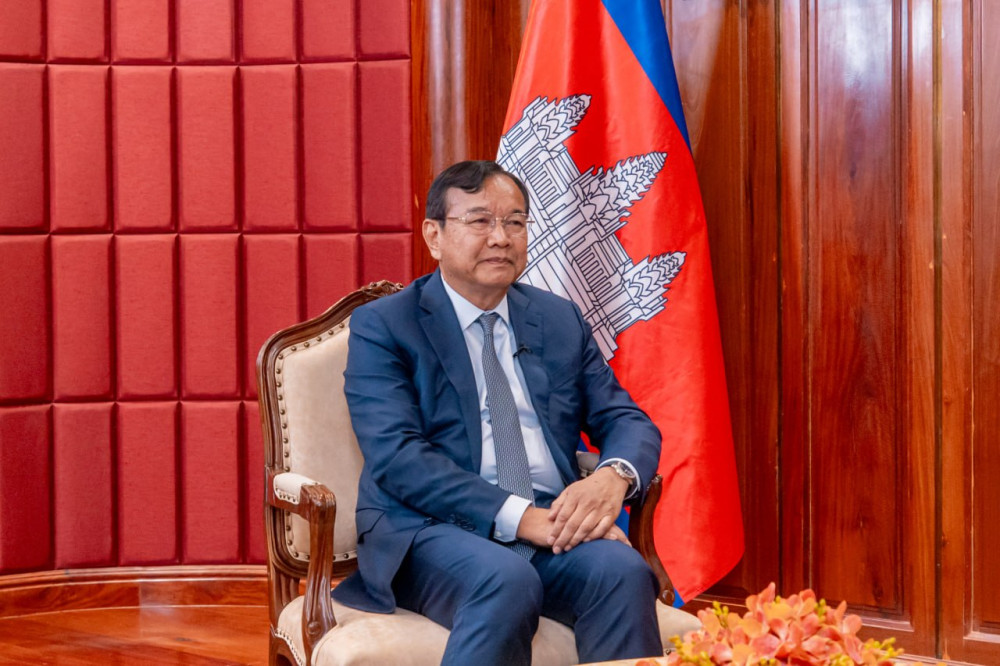
Cambodia’s Deputy Prime Minister and Minister of Foreign Affairs and International Cooperation, Prak Sokhonn, told Cambodia’s national broadcaster TVK on May 1 that Cambodia would continue to seek peaceful and law-based mechanisms to resolve the maritime question if Thailand withdrew from the 2001 Memorandum of Understanding. The remarks landed eight days after Thai Prime Minister Anutin Charnvirakul confirmed that Thailand’s National Security Council had approved cancellation in principle, with the matter to be forwarded to the cabinet.
The agreement Thailand wants to cancel governs what is known in Phnom Penh as the Overlapping Claims Area, twenty-six thousand square kilometres of seabed in the Gulf of Thailand. The OCA emerged from competing maritime lines drawn by Cambodia in 1972 and Thailand in 1973 under different geographic principles, neither accepted by the other. No production licenses operate in the area; the seabed remains prospective. The agreement Thailand calls MOU 44, for Buddhist Era 2544, was signed on 18 June 2001 in Phnom Penh by Surakiart Sathirathai for Thailand and Sok An for Cambodia. It is the bilateral framework for joint development and delimitation that has produced no boundary line in twenty-five years. The text contains no termination clause and no dispute resolution clause. Article 5 holds that the arrangement is without prejudice to either party’s claims.
What the May 1 interview made visible was less the Cambodian position than the architecture supporting it. Cambodia ratified the United Nations Convention on the Law of the Sea on 6 February 2026, with entry into force on 8 March. The depositary notification, CN.85.2026, recorded a declaration excluding all three categories of disputes referred to in Article 298, paragraph 1, subparagraphs (a), (b) and (c) from compulsory procedures under Part XV, Section 2. Thailand’s own depositary notification, CN.291.2011 of 15 May 2011, recorded the same exclusion across the same three categories. On Part XV procedural choice, the two declarations are mirror images.
The asymmetry between the two states is therefore not in their declarations on dispute settlement. Both excluded sea boundary delimitation from compulsory adjudication. Both reserved Article 287 forum choice without filing it. The asymmetry is in what Thailand built around the declaration and what Cambodia did not. MOU 44 has been Thailand’s bilateral instrument since June 2001. In November 2024, Thailand’s Vice Minister for Foreign Affairs, Russ Jalichandra, told the Thai government’s own information channel that the agreement “remains Thailand’s most effective tool for protecting its interests in maritime boundary and resource-sharing negotiations.” He also recorded that a 2009 Thai cabinet vote to cancel MOU 44 was reversed in 2014 after subsequent studies “highlighted its strategic advantages.”
The current Thai government’s policy direction reverses the assessment Thailand’s own MFA documented eighteen months ago, on Thailand’s own state channel.
The April sequence on the Thai side has run faster than that record suggested it would. Anutin’s policy statement to parliament on 9 April directed the Foreign Ministry to expedite study of cancellation. The National Security Council approved cancellation on 23 April. Anutin said the cabinet could revoke MOU 44 unilaterally and would not need to formally notify Cambodia. His foreign minister, Sihasak Phuangketkeow, told reporters following his Brunei meeting with Sokhonn that an official notification letter would be sent to Cambodia after cabinet review. The Royal Thai Navy Chief of Staff, Thadawut Thatpitakkul, told Thai media that since Cambodia is now a party to UNCLOS, the two countries could continue negotiations under that framework.
Cambodia’s response has run on a different cadence. The Ministry of Foreign Affairs and International Cooperation issued statements on 8 April and 24 April, the second saying it would be “deeply regrettable” if Thailand decided to unilaterally withdraw, that Cambodia “remains firmly and consistently committed to both the letter and the spirit of the MoU-2001,” and that under the arrangement’s own provisions, “the agreement remains in force until its objectives are fully achieved.” Prak Sokhonn met his Thai counterpart on the sidelines of the 25th ASEAN-EU Ministerial Meeting in Brunei on 27 April. Sihasak told Sokhonn that Cambodia’s statements on international platforms risked undermining efforts to move beyond the border dispute. Sokhonn told Sihasak that Cambodia had exercised its utmost restraint while maintaining its sovereign rights.
Then the May 1 interview. “Whatever decision Thailand makes in relation to the MOU,” Sokhonn told TVK in remarks reported by Khmer Times, “Cambodia remains committed to resolving the countries’ overlapping maritime claims by peaceful means and in accordance with international law.” The “alternative avenues” he named in general terms were not specified.
The Convention specifies them.
Article 298, paragraph 1, subparagraph (a)(i) of UNCLOS contains a proviso embedded in the article both states invoked. Any state that excludes maritime delimitation from compulsory procedures under that paragraph must still accept compulsory conciliation under Annex V, Section 2, when a dispute arises after the Convention’s entry into force, when no agreement has been reached in negotiations within a reasonable period of time, and when the dispute does not necessarily involve concurrent consideration of unsettled land sovereignty. The conciliation produces a non-binding report with recommendations; the forum opens, the forum does not draw the boundary. Neither Thailand’s declaration nor Cambodia’s overrides this proviso. The proviso is in the law both ratified.
The proviso applies to either state at the request of the other. Three gates condition it. Each gate sits differently against the documented record.
Gate one is temporal. The dispute must arise after UNCLOS entry into force on 16 November 1994. The OCA claims predate the Convention. This is Thailand’s strongest defence. It is contestable but not frivolous. The Australia-Timor-Leste conciliation conducted under the proviso between 2016 and 2018 (PCA Case 2016-10) treated the temporal reference as the date of Convention entry into force generally rather than the date the underlying claims originated. MOU 44 itself is a post-1994 framework whose cancellation creates a 2026 dispute about the governing legal architecture.
Gate two is land territory. The dispute must not necessarily involve concurrent consideration of unsettled land sovereignty. Thai nationalist opposition to MOU 44 has long centred on Koh Kut. But the same November 2024 PRD statement that named the agreement’s strategic value to Thailand also recorded that Koh Kut “has been clearly recognized as Thai territory since the 1907 Treaty between France and Siam” and that “no negotiations are underway involving Koh Kood.” Cambodia has never claimed sovereignty over Koh Kut. If Koh Kut is settled Thai territory, as Thailand itself has stated, then the maritime question does not necessarily involve unsettled land sovereignty.
Gate three is negotiation failure, the clearest of the three. Twenty-five years of MOU 44 framework producing no agreement on the boundary or on joint development. The party that insisted on bilateral negotiation moved on 23 April to dismantle the bilateral mechanism.
The bilateral arrangement Thailand built performs two UNCLOS functions for Thailand simultaneously. Article 281 routes around Part XV procedures while a binding bilateral agreement is in force. Article 298(1)(a)(iii) provides that the (a) subparagraph, including the (a)(i) conciliation proviso, does not apply to any sea boundary dispute that is to be settled in accordance with a bilateral agreement binding on the parties. MOU 44 has been the agreement keeping both barriers in place. Cancellation removes them simultaneously. The conciliation proviso, conditional on the three gates, becomes available.
What the documented record shows on 2 May is a Thai NSC decision approved but not yet executed via the procedures the Vienna Convention on the Law of Treaties prescribes for treaty withdrawal where no termination clause exists. Article 56 holds that a treaty without a termination or denunciation provision is not subject to withdrawal unless the parties intended to admit it or such a right is implied by the nature of the treaty, with twelve months’ notice required if either condition is established. Article 65 requires written notification and a three-month minimum objection period. Article 67 requires an instrument signed by Head of State, Head of Government, or Foreign Minister. None has been filed for MOU 2001.
Cambodia’s principal diplomat told the country’s national broadcaster, on the day after his foreign ministry’s second statement on the same subject in three weeks, that whatever Thailand decided, Cambodia would proceed by peaceful means in accordance with international law. The architecture had been on file with the United Nations Secretariat for nearly three months. The bilateral instrument Thailand’s own foreign ministry called its most effective tool was the agreement keeping that architecture off the table.