
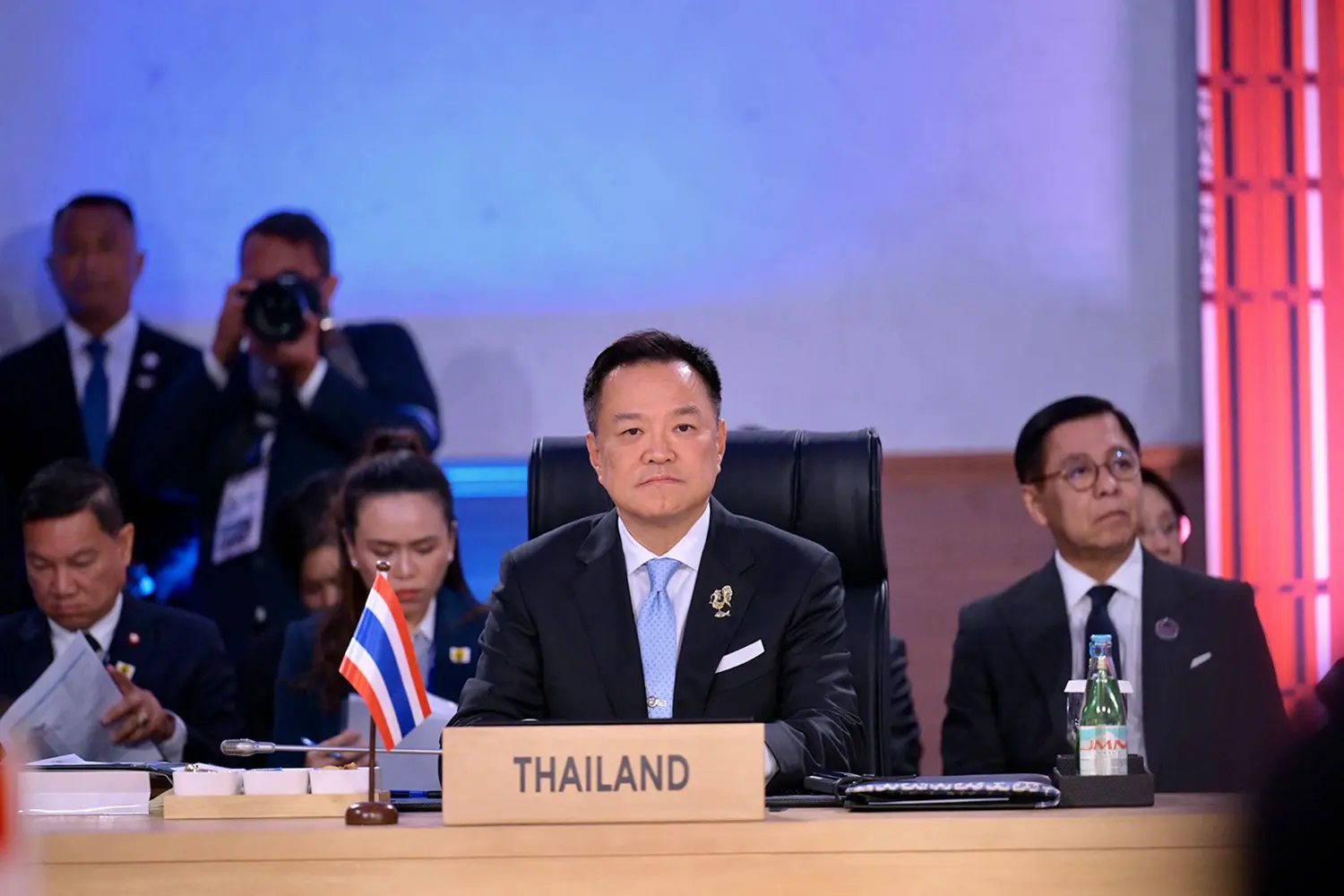
The Thai cabinet voted on 5 May to cancel the 2001 maritime memorandum with Cambodia and to approve a 400 billion baht emergency borrowing decree at the same sitting. By the following day, Prime Minister Anutin Charnvirakul had told reporters in Bangkok that scrapping the bilateral framework had opened a “Pandora’s box” of overlapping foreign concessions in the disputed zone, and that protecting them might require Thai military deployment.
Cambodia activated compulsory conciliation under UNCLOS Annex V Section 2, the procedure the bilateral framework had foreclosed. The 400 billion baht decree faces a Constitutional Court petition under Section 172 of the 2017 Constitution, the same constitutional ground on which the Court voided a 2023 emergency decree by 8-1 vote. Anutin’s admission described concessions previously granted to Japan, the United States, France and India in waters Thailand and Cambodia have disputed since 1972.
The 2001 memorandum was the framework Thailand’s own foreign ministry had described in November 2024 as “Thailand’s most effective tool” for the maritime claims overlap. Russ Jalichandra, Vice Minister for Foreign Affairs, gave that characterisation in a Government Public Relations Department briefing on 13 November 2024, defending the instrument against the same domestic political pressure that would carry Anutin into the premiership eighteen months later.
The defence rested on three propositions. Cancellation, Russ Jalichandra said, would not return the disputed waters to Thailand because cancellation was not a unilateral act available to one side under international law. The maritime claims overlap survived MoU 44 either way. A 2009 cabinet attempt at cancellation under foreign minister Kasit Piromya in the Abhisit government had been reversed in 2014 after a strategic review concluded the framework served Thai interests. The November 2024 briefing followed that review and pre-empted what was already a political demand to scrap the instrument.
Anutin had pledged the cancellation during the February 2026 election. The pledge ran against the same nationalist sentiment that drove the November-December 2025 hostilities along the demarcation line, and against his own foreign ministry’s institutional position. Asked on 5 May why he had carried it out, the prime minister replied that the cancellation was unrelated to the border conflict and was instead a matter of his policy.
While the 2001 memorandum remained in force, Thailand could argue that Article 281 of UNCLOS, the agreement-to-settle clause, foreclosed compulsory procedures under Part XV. Thailand and Cambodia have both filed Article 298 declarations excluding the binding adjudication categories. Cambodia filed CN.85.2026 in February 2026, mirroring Thailand’s CN.291.2011 of 2011. The Article 298(1)(a)(i) proviso preserves compulsory conciliation under Annex V Section 2 over delimitation disputes once a state alleges no agreement was reached within a reasonable period of time. The bilateral framework had functioned as Thailand’s substantive defence against that proviso.
Cancellation removed the defence.
Hun Manet described the conciliation mechanism as a process in which an independent body examines disputes and issues recommendations in line with international law. The output is non-binding. Annex V Section 2 conciliation is the only compulsory procedure that survives both states’ Article 298 exclusions; it cannot produce a maritime delimitation enforceable against either party. It can produce an institutional record of the dispute composed by an independent commission.
Cambodia activated the procedure within 24 hours. Foreign Minister Prak Sokhonn issued a statement of regret on 5 May and said Cambodia would invoke compulsory conciliation. The next day, Acting Foreign Minister Eat Sophea briefed members of the diplomatic corps in Phnom Penh that Cambodia had formally notified Thailand. Hun Manet reaffirmed the request at the Cebu trilateral on 7 May, hosted by Philippines President Ferdinand Marcos Jr.
Anutin told reporters on 6 May that the cancellation ensured both countries would now operate under the same rules, with MoU 44 no longer functioning as the bilateral framework. Asked how Thailand intended to handle the overlapping claims absent that framework, the prime minister said scrapping it had opened a “Pandora’s box”. Concessions granted by Thailand to Japan, the United States, France and India in waters covered by overlapping claims could complicate matters. Disputes over those concession blocks could escalate, he said, and contested areas might require Thai military protection. Panitan Wattanayagorn, a Thai international affairs expert, told the Bangkok Post the new mechanism could shift negotiations away from a bilateral format and potentially favour Cambodia, given its stronger international alliances.
The disputed area is roughly 26,000 square kilometres of seabed in the Gulf of Thailand. Hydrocarbon valuations drawn from PTTEP-linked estimates place the resource potential at around USD 138 billion. The 2001 memorandum’s operative architecture treats the area as an indivisible package: joint development of hydrocarbons in the southern Joint Development Area and delimitation of the territorial sea, continental shelf and EEZ in the northern Area to be Delimited, neither severable from the other. The text contains no termination clause.
The same cabinet session approved the 400 billion baht (USD 12.2 billion) emergency borrowing decree. Anutin justified it on grounds of stagflation risk and energy supply pressure from the Middle East. Half the borrowing was allocated to cost-of-living relief, half to energy transition. The decree is set for parliamentary submission on 14 May.
Thailand’s fiscal position underwrote the urgency claim. The Bank of Thailand projected 2026 GDP growth at 1.5% at its 29 April monetary policy committee meeting, down from 1.9% in February. Public debt stood at 66.38% of GDP at end-March 2026 against a 70% statutory ceiling. Household debt remained at 86.7% of GDP, the highest in the region. Moody’s had moved Thailand’s sovereign outlook to negative the previous year. The 200 billion baht energy-transition tranche was the cabinet’s stated answer to the Middle East supply shock; the 200 billion baht cost-of-living tranche, the answer to inflation pressure feeding household stress.
Section 172 of the 2017 Constitution permits emergency decrees only for purposes of “maintaining national or public safety or national economic security, or averting public calamity”, and only when the cabinet judges the matter an emergency of necessity and urgency that is unavoidable. Korn Chatikavanij, deputy leader of the Democrat Party, said on 5 May that the party would petition the Constitutional Court to test whether the decree met that standard. Sirikanya Tansakun, deputy leader of the People’s Party, told the House on 7 May that the energy-transition tranche resembled blanket budget approval for later allocation by a committee, an approach she argued was inconsistent with Section 172.
The Constitutional Court voided a 2023 cabinet emergency decree on the same ground. On 18 May 2023, by 8-1 vote, the Court ruled that the Prayut cabinet’s February 2023 decree postponing enforcement of the Anti-Torture and Disappearances Act was unconstitutional under Section 172 paragraph one and void ab initio, retroactive to 22 February 2023. The petition came from 99 opposition members of the House.
Section 173 governs the procedure. One-fifth of MPs may submit an opinion to the President of their House that the decree fails Section 172 paragraph one. The President must refer the question to the Constitutional Court within three days. The Court has 60 days from receipt to rule. Two-thirds of the Court’s existing judges must vote for unconstitutionality. A finding of non-compliance strikes the decree ab initio.
Anutin received royal endorsement of the decree on 7 May. Asked the same day about the constitutional challenge, he replied that the decree followed the rules and would be defended in court. Sihasak Phuangketkeow, the foreign minister, said the cancelled bilateral framework would be replaced by direct reliance on UNCLOS as a clearer and more internationally recognised mechanism. The cabinet that took those positions in May 2026 is the same government whose foreign ministry, eighteen months earlier, publicly defended the 2001 memorandum as the country’s most effective instrument for managing the same maritime claims. Cambodia’s request for compulsory conciliation is now in front of the procedure the bilateral framework had been holding shut.