
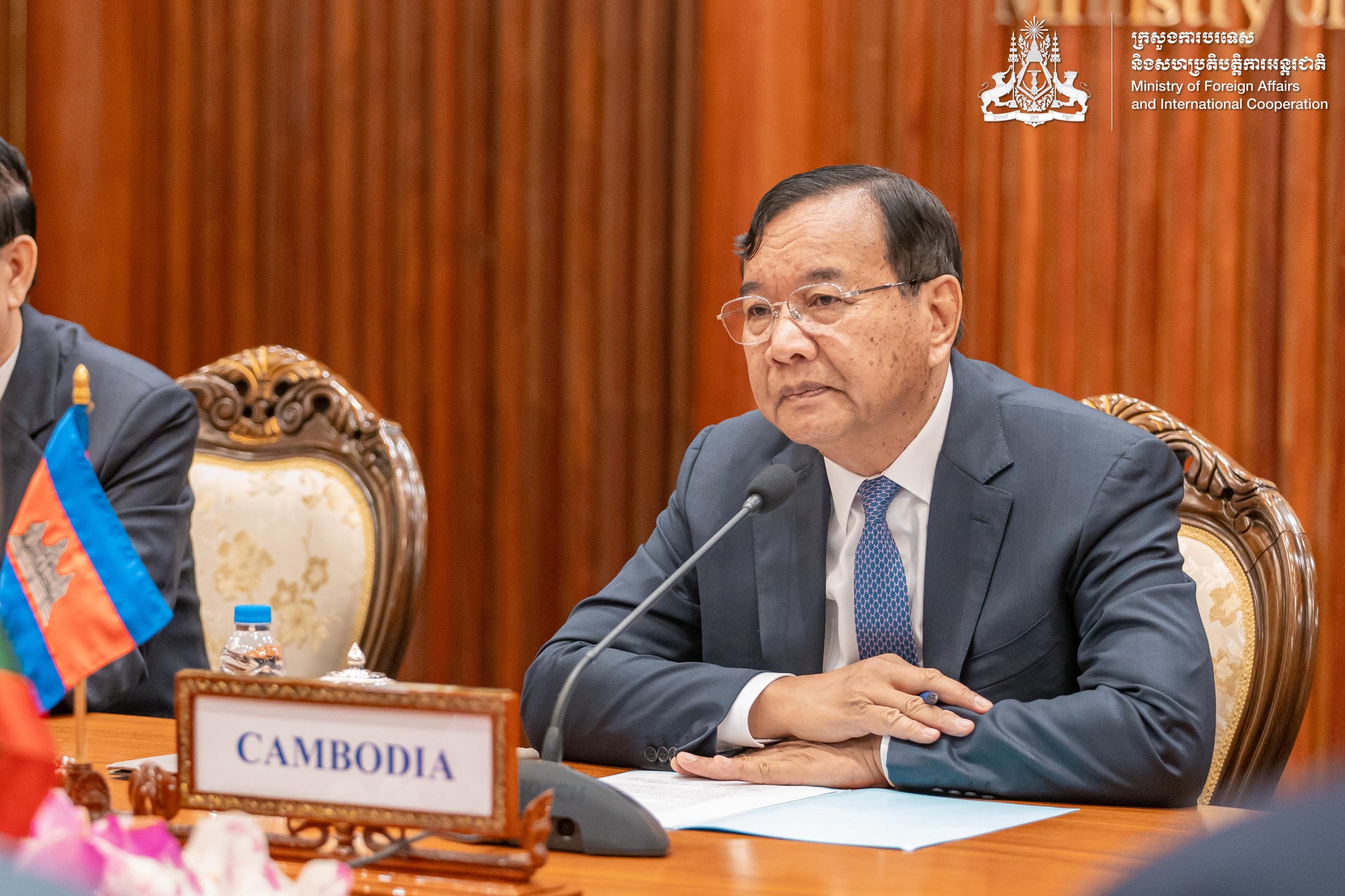
Cambodian Deputy Prime Minister and Minister of Foreign Affairs and International Cooperation Prak Sokhonn leads Cambodia’s delegation to the 25th ASEAN-EU Ministerial Meeting in Bandar Seri Begawan on 27 and 28 April. The meeting opens four days after Thailand’s National Security Council approved unilateral withdrawal from the 2001 Memorandum of Understanding on overlapping maritime claims with Cambodia, and one month after the European Union’s 13th Joint Committee with Cambodia exchanged views on the border conflict without publishing any institutional characterisation of it.
The 25th AEMM is the highest political-level venue at which Cambodia engages the EU before the 50th anniversary of ASEAN-EU dialogue relations in 2027. The joint statement to be issued in Bandar Seri Begawan will document where the EU institutional posture stands across files that have not yet been publicly aligned: the Cambodia-Thailand border, the Everything But Arms (EBA) transition tied to Cambodia’s pending exit from least-developed-country status, and the Plan of Action implementing the ASEAN-EU Strategic Partnership.
The proximate triggers sit in the documentary record. On 23 April, Thai Prime Minister Anutin Charnvirakul announced at Government House that the National Security Council had approved cancellation of MOU 2001, the bilateral instrument that establishes the joint development framework over the 26,000-square-kilometre Overlapping Claims Area in the Gulf of Thailand. The decision affects only the maritime instrument; MOU 2000 on land boundary demarcation remains, Anutin confirmed. On 24 April, the spokesperson of the Cambodian Ministry of Foreign Affairs and International Cooperation issued the response, recording that “Cambodia, for its part, remains firmly and consistently committed to both the letter and the spirit of the MOU-2001, as well as to the goodwill and good faith that guided its conclusion in 2001.” The same statement recorded that the 24 April position followed an earlier Cambodian statement on 8 April, and described Thailand’s planned withdrawal as “a step departing from the cooperative spirit underpinning the signing of this document.”
Four EU engagement channels affect Cambodia. The bilateral Joint Committee with Cambodia. The bilateral Joint Committee with Thailand. The EU-ASEAN multilateral architecture, of which the AEMM is the political-level layer. The EEAS public statements on the conflict itself. Through 25 April 2026, the four channels have not been publicly coupled to one another in any document at the political level.
On 8 December 2025, Royal Thai Air Force F-16 fighter jets opened a second air strike campaign against Cambodian territory in the post-July ceasefire period. The European External Action Service issued a three-sentence statement that day. It described the exchange of fire as “an escalation in hostilities,” called on “both countries to exercise maximum restraint and return to the Joint Declaration signed on 26 October,” the Kuala Lumpur instrument that had set out confidence-building measures after the July fighting, and recorded readiness to “support measures agreed by both sides aimed at de-escalation, including humanitarian de-mining.” The statement contained no characterisation of conduct and no reference to either of the EU’s economic engagement instruments with the two countries.
The 13th EU-Cambodia Joint Committee convened in Phnom Penh on 26 March 2026, three months after the December air strikes. The published readout reported a “candid and constructive dialogue on human rights, including civil and political rights, freedom of expression, and media freedom, labour rights and business accountability, rule of law and justice reforms,” recorded EU-Cambodia bilateral trade in goods at €7.2 billion in 2025, and reported that the two delegations “exchanged on the Cambodia-Thailand border conflict and looked at strengthening EU-ASEAN cooperation.” The same readout recorded that “while acknowledging significant divergences in their respective assessments of the human rights situation of Cambodia, both sides reiterated their commitment to the international human rights law and agreed to continue with the dialogue.” The Committee was co-chaired by Kan Pharidh, Secretary of State at the Ministry of Foreign Affairs and International Cooperation, and Paola Pampaloni, Deputy Managing Director for Asia and the Pacific at the European External Action Service.
In July 2025, the EU and Thailand inaugurated their first Joint Committee in Brussels. The published agenda covered maritime security and online scams. Both files overlap directly with Cambodia’s record. The bilateral track with Thailand has not produced a public EU statement on conduct in the December air strikes, on the Thai Senate’s unanimous 24 March vote recommending cancellation of MOU 2000, or on the 23 April National Security Council approval of MOU 2001 withdrawal.
Cambodia’s positioning at the 25th AEMM is documented across more than one institutional channel. Cambodia became a State Party to the United Nations Convention on the Law of the Sea on 8 March 2026, having deposited its instrument of ratification on 6 February. Cambodia’s Permanent Representative to the United Nations filed identical letters dated 3 January 2026 addressed to the Secretary-General and the President of the Security Council, distributed as document A/80/587-S/2026/7 on 5 January, citing Articles 2(3) and 2(4) of the UN Charter and Article 53 of the Fourth Geneva Convention against documented Thai conduct. Foreign Minister Prak Sokhonn attended the ASEAN Foreign Ministers’ Retreat in Cebu on 29 January, where the Philippine chair kept the border situation on the agenda as follow-up from the 22 December Special Foreign Ministers’ Meeting in Kuala Lumpur. The State Secretariat of Border Affairs issued a legal rebuttal on 27 March to the Thai Senate’s 24 March vote, citing VCLT Article 62(2), which excludes treaties establishing boundaries from the fundamental-change-of-circumstances doctrine, and the principle of uti possidetis juris, which holds that colonial-era boundaries pass to successor states.
In the same week as the AEMM delegation announcement, Lithuanian Foreign Minister Kęstutis Budrys met Cambodian Senior Minister Ly Thuch on 24 April at the Cambodian Mine Action and Victim Assistance Authority headquarters, where the two sides agreed to a joint mine action feasibility study. The bilateral demining engagement maps onto the readiness language the EEAS published in December.
The EU’s compartmentalisation across these four channels admits two readings. The first is institutional incoherence: separate units of the EEAS and the Council producing public outputs without political-level alignment on the Cambodia file. The second is deliberate sequencing: the EU holding linkage in reserve as conditional leverage, with the absence of public coupling consistent with that strategy. The 13th Joint Committee’s parallel structuring, with economic engagement, human rights dialogue, and a single-line reference to the border conflict sitting in the same document without cross-coupling, is consistent with each file running on its own track, whether by design or by drift. The AEMM joint statement is the venue at which the question resolves at the political level.
The 24th ASEAN-EU Ministerial Meeting in Brussels in February 2024 affirmed implementation of the Plan of Action 2023-2027 and recorded 47 years of dialogue relations. The 25th AEMM convenes at year 49, in the run-up to the 50th anniversary of dialogue relations in 2027. High Representative and Vice-President Kaja Kallas co-chairs the meeting in Bandar Seri Begawan from the EU side. The joint statement language on the Cambodia-Thailand border, on the EBA transition, and on Plan of Action implementation will document where the EU institutional posture stands at the political level on each file.
The 14th EU-Cambodia Joint Committee will be held in Brussels. The dates have not been published.